How to Calculate Net Run Rate (NRR) in Cricket: Your Comprehensive Guide
In the dynamic world of cricket, where every run and every wicket can tip the scales, the Net Run Rate (NRR) stands as a pivotal metric. More than just a statistic, NRR is often the ultimate arbiter in multi-team tournaments, deciding which teams advance and which go home when points alone can't separate them. Introduced during the 1992 ODI World Cup, NRR has become an indispensable part of limited-overs cricket, reflecting a team's overall dominance – or lack thereof – throughout a competition. Understanding how to calculate Net Run Rate is crucial for any avid cricket follower, fantasy player, or aspiring analyst.
Think of NRR as cricket’s equivalent of ‘goal difference’ in football leagues. It’s a sophisticated tie-breaker that goes beyond simple win-loss records, delving into the efficiency with which a team scores and concedes runs. While it might sound complex at first glance, the underlying Net Run Rate explained through its formula is quite straightforward once you break it down.
What Exactly is Net Run Rate (NRR)?
Net Run Rate (NRR) is a statistical tool used to rank teams in round-robin format tournaments when they are level on points. It quantifies the difference between the average number of runs a team scores per over and the average number of runs it concedes per over. A higher (more positive) NRR indicates a stronger overall performance, as it means the team has generally scored runs faster than its opponents while conceding them slower.
This metric is predominantly used in limited-overs formats such as One Day Internationals (ODIs), Twenty20 (T20s), and T10 cricket, where the number of overs is a fixed and significant factor. In Test cricket, where overs played have less direct correlation with match outcomes and are not fixed, NRR holds little to no relevance. The beauty of NRR lies in its ability to provide a deeper insight into a team's attacking and defensive prowess over the course of a tournament, encouraging not just wins, but dominant wins, and minimizing heavy defeats.
The Fundamental Net Run Rate Formula: Match-by-Match Breakdown
Calculating Net Run Rate can be approached in two ways: for a single match, and cumulatively for an entire tournament. Let's start with the basics – determining a team's NRR for an individual game.
The Net Run Rate of a team in a specific match is calculated by subtracting the average number of runs conceded per over by that team from the average number of runs it scores per over. Essentially, it’s your team’s run rate minus the opposition’s run rate in that particular contest.
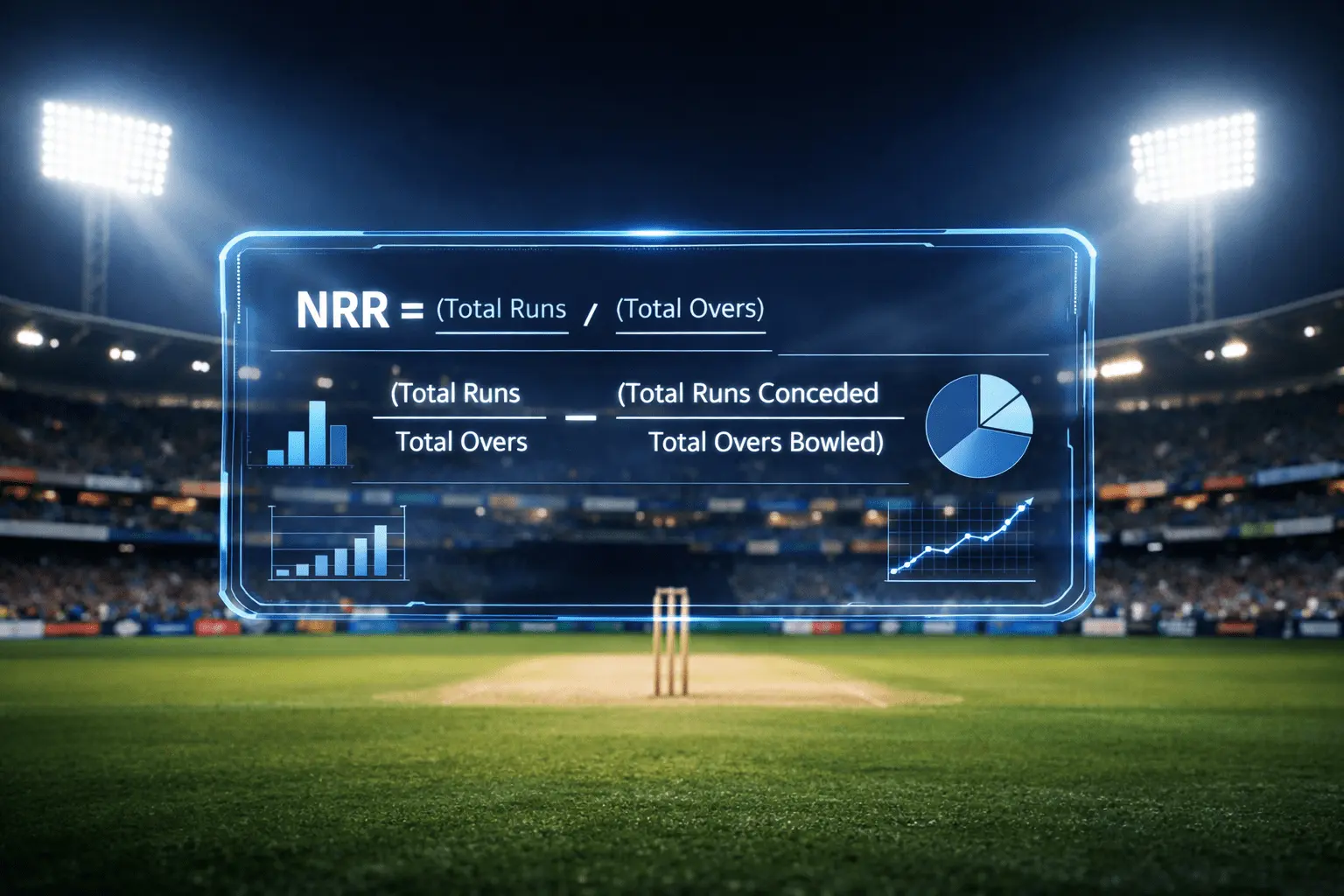
The Net Run Rate (NRR) formula for a single match is:
- Team's Run Rate = (Total Runs Scored by Team in Match) / (Total Overs Faced by Team in Match)
- Opposition's Run Rate = (Total Runs Scored by Opposition in Match) / (Total Overs Faced by Opposition in Match)
- NRR for Match = Team's Run Rate - Opposition's Run Rate
Practical Example: Calculating Match NRR
Let’s walk through a common scenario to illustrate the calculation:
Suppose in an ODI match:
- Team India scores 287 runs for the loss of 5 wickets in their allotted 50 overs.
- Team New Zealand, in response, scores 213 runs for the loss of 8 wickets in their allotted 50 overs.
To calculate India's NRR for this match:
- India's Run Rate: 287 runs / 50 overs = 5.74 runs per over
- New Zealand's Run Rate: 213 runs / 50 overs = 4.26 runs per over
- India's NRR for the match: 5.74 - 4.26 = +1.48
In this example, India secures a positive NRR of +1.48, reflecting their superior performance in terms of run scoring efficiency. Conversely, if a team loses a match, its NRR for that particular tie will inevitably be negative. A higher (more positive) NRR is always more desirable.
Calculating Net Run Rate Across a Tournament
While the single-match NRR is useful, its true power comes to light when calculated cumulatively across an entire tournament. This aggregate figure is what ultimately decides rankings when teams are level on points.
The formula for a team's Net Run Rate (NRR) throughout a competition is:
- Overall Team Run Rate = (Total Runs Scored by Team in All Matches) / (Total Overs Faced by Team in All Matches)
- Overall Opposition Run Rate = (Total Runs Scored by Opposition Against Team in All Matches) / (Total Overs Bowled by Team in All Matches)
- NRR for Tournament = Overall Team Run Rate - Overall Opposition Run Rate
It’s important to note that "Total Overs Faced by Team" refers to the overs played while batting, and "Total Overs Bowled by Team" refers to the overs bowled while fielding. These are often tracked separately for precision in NRR calculations.
Crucial Nuances and Special Rules in NRR Calculation
While the basic formula for cricket's NRR seems straightforward, there are several key pointers and special cases that make its accurate calculation slightly more intricate:
Handling Incomplete Overs
Cricket overs aren't always neat whole numbers. A team might bat for 47.2 overs, meaning 47 overs and 2 balls. For NRR calculation, this isn't simply 47.2. Instead, the fractional part needs to be converted into a decimal representing the fraction of an over. Since an over comprises six deliveries, 2 balls out of 6 is 2/6, which simplifies to 1/3 or approximately 0.333.
Therefore, 47.2 overs would be represented as 47 + (2/6) = 47.333 overs for calculation purposes. This precision ensures that even single balls can impact the crucial run rate.
The "All Out" Rule
This is one of the most significant and often misunderstood rules in NRR calculation. If a team is all out (bowled out) in less than their full quota of allotted overs (e.g., in the 40th over of a 50-over match), for the purpose of NRR calculation for their opponent, it is considered that the bowling team has bowled their full quota of overs. Let's clarify:
- For the batting team (who got all out): Their "overs faced" will be the actual number of overs they batted (e.g., 40 overs).
- For the fielding team (who bowled them out): When calculating the opposition's run rate (the denominator for runs conceded), the number of overs used will be the full quota for the match (e.g., 50 overs for an ODI, 20 overs for a T20), not the actual overs they bowled to get the opposition all out.
Example: Team A bats for 35 overs and scores 180 runs before being all out in a 50-over match.
- When calculating Team A's run rate: 180 runs / 35 overs = 5.14 RPO.
- When calculating Team B's (the fielding team's) overall NRR, the "overs faced by opposition against Team B" for this match will be counted as 50 overs, NOT 35 overs, for the purpose of determining Team B's runs conceded per over.
This rule prevents teams from artificially boosting their NRR by quickly bowling out opponents for low scores in fewer overs, ensuring the calculation truly reflects overall run-scoring and conceding efficiency over the available duration.
Matches with Reduced Overs (DLS Method)
When matches are shortened due to weather or other interruptions, and targets are revised using methods like the Duckworth-Lewis-Stern (DLS) method, these adjusted figures are used for NRR calculations. The original full quota of overs is discarded, and the new, reduced number of overs and the revised target runs are taken into account for both run rates.
No Result and Abandoned Matches
Matches that are declared "no result" or are abandoned without a ball being bowled generally do not count towards Net Run Rate calculations. The runs scored and overs faced/bowled in such matches are simply not factored into the cumulative tournament NRR.
Super Overs
A crucial point for fans of nail-biting finishes: any runs scored or conceded in a Super Over (the tie-breaker used in knockout stages or finals of limited-overs matches) are not counted towards a team's Net Run Rate. Super Overs are separate entities for deciding a match winner and do not influence a team's overall tournament standing via NRR.
Why Understanding Net Run Rate is Strategically Important
Beyond being a mere tie-breaker, NRR has a profound impact on team strategies throughout a tournament:
- Aggressive Play: Teams often bat aggressively even when a win is secured, aiming to boost their NRR by scoring runs quickly.
- Damage Limitation: Similarly, teams that are losing might try to extend their innings or score as many runs as possible to minimize the negative impact on their NRR, even if a win is out of reach.
- Tournament Dynamics: As a tournament progresses, teams become acutely aware of their NRR standing relative to competitors. This can influence team selection, batting orders, and bowling changes, turning every delivery into a high-stakes event.
- Qualification Scenarios: In tightly contested groups, NRR can be the difference between making it to the semi-finals or being knocked out, even if two teams have the same number of wins and points.
Tips for Tracking and Interpreting NRR
Keeping an eye on Net Run Rate can significantly enhance your appreciation of cricket tournaments:
- Focus on Averages: Remember that NRR is all about average runs per over. A high-scoring win helps, but a high-scoring loss can still be better than a low-scoring thrashing if you manage to bat for longer.
- Utilize Online Tools: Many cricket websites and apps provide live NRR updates and calculators, taking the mathematical burden off your shoulders.
- Consider the Context: A negative NRR early in a tournament isn't necessarily a death knell if a team has played strong opponents. Look at the NRR trend as the tournament progresses.
- Dominant Wins are Key: To significantly improve NRR, teams need not just to win, but to win comprehensively – either by chasing a target quickly or by bowling out opponents for a very low score.
Conclusion
The Net Run Rate is far more than just a supplementary statistic in cricket; it's a strategic pillar of limited-overs tournaments. From its introduction in 1992, it has evolved into a critical determinant of team standings, rewarding consistent performance and efficient play. By understanding the core formula, the nuances of overs calculation, and special rules like the "all out" provision, you can gain a much deeper appreciation for the tactical battles unfolding on the pitch. So, the next time you're following a close tournament, remember that every run and every over contributes to the powerful metric that is Net Run Rate, potentially shaping the destiny of your favorite team.